After reading through the website, if you still have unanswered questions that you would like answering either prior to booking, or before taking your lessons, please feel free to contact us at: mail@fiss.jp
If your holiday budget allows, then private lessons will give you the optimal environment to quickly progress. Our private lessons allow you to choose to have up to 5 people in the lesson.
For the ultimate learning experience taking a private lesson individually is best. This allows the instructor to truly tailor every aspect of the lesson to your specific individual needs and desires. The instructor can choose the optimal terrain and pacing for your fastest possible skill aquisition.
The next best option after individual lessons, is to take a private with up to 5 people with similar abilities. The closer the individuals are in ability, speed and slopes they frequent, the better the lesson will be from a learning perspective. In this scenario the instructor can again tailor the lesson with minimal compromises needed.
For some people, especially families the speed of learning may be of less overall importance than the overall experience. This is especially true at a beginner level, many families want to have a shared experience of learning a new sport together. With a diverse age range, the reduced rate of skill aquisition is accepted as the speed of learning becomes secondary to the laughs and enjoyment. The lesson is tresured in the future as a great family experience.
Once the family have progressed from the first day on snow however, it becomes more enjoyable to split into ability/age specific groups. In this situation if a family had booked a private, it would be most beneficial to split the lesson time between the diferent ability groups.
Reading the information below regarding mixed abilities and children/adults will explain this further.
If you are a lone traveler, often group lessons are a budget friendly option. As the name implies these lessons have many people joining the lesson. They each bring with them their own desired goals, skill set and experience. Although groups are organised into ability levels, they will always be a compromise to best accomodate the group.
Group lessons work best when the group is as homogenous as possible. First timer group lessons work the best, but even at this level splits in ability can quickly form as some people will naturally pick up the new skills more quickly than others.
Through the intermeadiate levels it is actually more cost effective long term to take private lessons.
At an expert level, goal specific advanced camps work, as again a group containing people with that amount of skill and experience will be more likely to be similar.
At FISS, we appreciate the limitations of intermeadiate group lessons, so only offer group lessons to first timers and offer both private and advanced camps to expert skiers.
If you are new to winter sports, you may be wondering what are the differences between skiing and snowboarding.
Skiing requires two skis, two ski poles and ski boots (see the video above). With skiing you face forwards like walking or running so for many feels more natural.
As both legs can move independently, it is far easier to balance and move on skis at a beginner level. Learning to ski normally involves far less falls than learning to snowboard, so if you are worried about injuries skiing is a safer option. Becoming profficient enough to explore the mountain will take longer on skis but once mastered skiing is faster and makes accessing remote locations far easier.
Snowboarding requires just one snowboard and snowboard boots (again see the video above). The boots are far more pleasant than ski boots which tend to be somewhat uncomfortable and difficult to walk in. With snowboarding there is less equipment and the learning curve is very rapid, most snowboarders can explore considerable amounts of the mountain after about three days.
With snowboarding you will stand sideways with both feet locked into the board by the bindings. As this eliminates much of the independence of the legs, it makes stepping out with one foot to regain balance impossible and hence normally people learning snowboarding for the first time will fall a lot for the first three days. This either do it right or fall over aspect of snowboarding is what makes the learning curve so rapid. If you don't have time to become good at skiing and you don't mind falling over repeatedly, snowboarding will quickly open up more of the mountain. Snowboarding may also feel more natural to individuals that skateboard or surf. Experience in either of these sports will greatly speed the rate in which you pick up either snowboarding or skiing.
First-Timers are people who have never been on skis or a snowboard before and will be mastering the basics on the flat before progressing to the magic carpet area.
Beginners are those who have the ability to stop on skis or a snowboard, and will be working on side-slipping(SB) and turning on the beginner area while gaining confidence and skills to work towards green runs.
Novices are people who want to learn to turn more confidently on green trails while gaining confidence and skills to work towards blue runs.
Intermediates are people who can get around the mountain on green and blue runs, who are working on parallel turns on skis or edge control on their snowboard and are looking for an introduction to different snow conditions and terrain choices.
Advanced skiers/snowboarders are taking their skiing and riding to the next level by refining their skills all over the mountain, trying something new with confidence, exploring the mountain both on and off-piste.
Lessons are sold on a first come first served basis (like hotel rooms & airline flights).
For busy periods such Xmas, New Years and Chinese New Years holidays booking well in advance is highly recommended. These periods sell out quickly with many of our guests booking up to a year in advance. In a typical year, around 80% of our lessons for these periods will already be sold by late September.
For non peak holiday periods we tend to still have availability closer to the lesson period, however prior booking is still recommended.
We tend to sell out quickly and walk in guests are often faced with us already being fully booked. During the off peak parts of the season, we do sometimes have some limited availability for guests turning up at the start of their holidays enquiring about availability. However if you want to ensure that you get your lessons then prior booking is definitely advised.
Skiing and snowboarding although sharing many characteristics are two separate sports.
Combining them in a lesson would be similar to taking a golf lesson and having someone with a tennis racquet and balls turn up (Again there are similarities... both involve hitting a ball with an object).
We do have instructors qualified to teach both (just as there are some golf coaches who can teach tennis). In the tennis/golf analogy, you could hit a tennis ball with a racquet around a golf course. In the same manner skiers and snowboarders can ride together down the slope and enjoy each others company.
The problem in a lesson environment however comes when the instructor needs to present a skill to develop. The instructor will do this by describing the desired outcome and combine this with a visual demonstration. Even if the instructor can both ski and snowboard, they can physically only wear one set of equipment at a time (either skis or a snowboard). If they wear skis then any skiers in the group will benefit from both aural explanations and demonstrations, whereas snowboarders in the group will only be able to get an aural explanation as the instructor will be unable to perform a snowboard demonstration on skis. If the instructor is wearing a snowboard then the snowboarders would benefit from explanations and demonstrations and this time the skiers will be disadvantaged.
As one group (skiers or snowboarders) are disadvantaged by sharing a lesson we strongly discourage people from booking such lessons. Obviously we understand there may be situations where someone wants to accompany those in the lesson on different equipment but doesn't necessarily want to be taught themselves.
Can we have individuals with big variances of ability in the same lesson?
In a lesson with only one individual, the lesson is delivered at a pace and in a manner tailored to their specific needs and wishes. In particular the terrain can be chosen to optimally allow them to acquire the skills being developed.As the number of individuals increases, the lesson increasingly becomes a compromise of what is best for the group as a whole.
With this in mind, lessons with lots of people work best when the group is as homogeneous as possible. Similar ability, goals, speed and experienced at skiing similar terrain and pitches.
Once you start having differences in goals, ability, speed, comfort level on slopes etc the lesson starts to become less enjoyable for everyone. The greater those differences, the greater the impact on all the participants. In lessons where there is a split in terms of ability, the instructor must for safety reasons base the whole lesson around the person with lowest level of ability. An expert skier/ rider can get down an easy slope or reduce speed to match a slower individual. If however you take a beginner and try to force them down a steep run or increase the speed beyond what they are technical able to cope with, the risk of injury to that person escalates at an alarming rate. For this reason, the instructor will stay on the appropriate terrain and at an appropriate speed for the person/people in the group with the lowest ability. The instructor would then have to give tasks to those of higher ability to occupy and challenge them at slower speed and shallower slopes than they would normally prefer.
The more advanced members of the group often get frustrated at the slow pace and the less advanced members start to feel pressure from the advanced members frustration, feeling they are expected to hurry up or offer to ski/ride steeper terrain . This does not create the best learning environment and these mixed ability lessons only work if the advanced members accept they will need to ski/ride at the speed and on the appropriate terrain for the others.
For the reasons above, we would normally attempt to discourage anyone other than close family/spouse/ best friends etc from taking lessons with a large split in ability. Obviously, In some cases such lessons do work well and if that is really what you desire, then once we have forewarned you of possible difficulties in this lesson type we will of course allow you to make such bookings.
Another option when dealing with a split in ability would be to book a longer lesson and split the time between the ability levels. This then would allow the instructor to focus solely on the individuals presently being taught and use appropriate terrain, pacing etc. For example if you had booked a 5hr lesson, the first timer in the party may take the fist couple of hours to get started and moving. The expert and the intermediate skiers or riders could use this time to warm up. The expert could go for an hour get some pointers and then let the intermediate skier/riders take the last couple of hours. This is an example and you may wish to split your lesson time differently. We allow up to 5 people total in a lesson.
The first things to consider when thinking about ski lessons are firstly your desired goals for the lessons and secondly your budget.
Children and adults tend to have differing preferences for delivery of information and pacing of the lesson. Adults tend to want detailed explanations of what they attempting, the benefits, and how to go about achieving success at the task. They want to attempt, and get frequent feedback on perfecting the task at hand. Children on the other hand tend to get impatient with lengthy aural communication. They prefer to be given a task and learn by trial and error while attempting the task. They like to keep moving and want the lesson to be dominated by practice time. This difference in desired communication styles and pace of delivery can often lead to frustration for the individuals involved. Children often get bored in lessons geared towards adults. Conversely, adults often leave lessons focused on children with many unanswered questions feeling they didn't learn a great deal. To add to this confusion, children go through stages of development as they grow in terms of their physical, mental and emotional capabilities. A 13 year old would want a very different lesson to a 3 year old of the same ability. In order for your lesson to be successful you then need to consider the goals of the individuals involved.
People book ski and snowboard lessons with very different desires.
For example: Is the primary goal the acquisition of skills or perhaps something else like a family experience? Some parents want to hang out in a lesson with the primary focus of watching their kids progress, others want to have the whole family become as proficient as possible.
If learning to ski or snowboard is the primary focus then optimally the fewer people in the lesson and the closer they are in age and ability the better. Children and adults should be in separate classes and everyone should be in either individual lessons or grouped in the same abilities.
In the situation where the parents want to make it a family experience and care less about learning and progression, a family private would work. The parents and children share the lesson and everyone accepts the diminished rate of skill acquisition as the price to pay to enjoy each others company. If your kids enjoy doing things with you and are patient in nature this could work well, if however your children easily get bored hanging out with you then this is not your best option.
Once you have decided what your goals are, next you need to consider the budget you have set aside for the lessons.
If learning is the primary focus then, in an ideal world taking lessons individually is the best option. This allows the lesson to be focused solely on the individual and their desired goals, the delivery and pacing of the lesson is then tailored to the individual.
Although optimal, this however can prove costly if traveling with a large number of individuals. If taking individual lessons is outside of the planned budget then the next best thing is to organize the party into groups of individuals of the same ability and similar ages and goals. Each specific group then takes a lesson to work on their needs. If this still falls outside the desired budget then taking a cheaper longer lesson and then splitting the time between the various groups could work. For example: Grandma who is a beginner does the first hour, the intermediate kids do the next two and the adult experts do the last two hours of a five hour lesson.
If the primary focus is being together in a family unit then you can just organize lessons based on the time frame desired up to a maximum of 5 people in the class.
For those not used to skiing or coming from countries without cold winters, you will need to wear considerably more clothing than you would perhaps be accustomed. Wearing lots of layers is best as these trap warm air between them. Having lots of layers will give more options to adjust to changes in the weather. If it is warm you can shed a layer or two, conversely if it gets cold you can add layers.
It is best to avoid fabrics like cotton that absorb lots of water. Fabrics saturated with water will likely freeze on very cold days and water takes considerable amounts of energy from your body to heat. Wearing such fabrics will result in feeling much colder and could eventually lead to conditions such as hypothermia. Instead wearing fabrics such as merino wool or synthetic fabrics like polypropylene that absorb less water will result in you staying drier and warmer.
It is best to start with thin base layers next to the skin. These wick moisture away. On top of this base layer use heavier mid layers, then fleece, down or synthetic equivalent garments and finally waterproof & windproof shell jacket and ski pants.
Hands should be kept warm with either mittens or gloves. Mittens are warmer than gloves, but gloves give more dexterity. Whichever you decide they should be good quality and have good padding to provide insulation for the hands.
A helmet or hat is needed to cover your head. We would very strongly recommend a helmet as this will also provide a degree of head protection in the event of a fall.
Sunlight will reflect off the snow, so sunglasses or goggles are essential to provide eye protection. For the same reason sunscreen is also recommended to protect exposed skin from sunburn.
Off-piste refers to terrain with un-groomed snow both outside and within the ski area boundary. It refers to snow that has been left in its natural state and the conditions vary depending on the recent weather conditions and volume of skiers and boarders that have been there before. You could get conditions ranging from powder to icy. It is these variations in conditions and the challenges associated with successfully navigating them that makes off-piste skiing and snowboarding fun for expert skiers and riders.
Terrain within the ski area is controlled for safety by ski patrol. The work carried out by ski patrol significantly reduces the risk of avalanches off-piste within the ski area boundary. The off-piste within the ski area boundary is patrolled by ski patrol and they will come to your rescue should the need arise. Most travel insurance policies for skiing also cover you for accidents, medical and rescue costs for incidents that occur within the ski area boundary (Check your policy).
As a ski school operating on the ski area, we are able to offer lessons to develop skills for off-piste skiing/riding and take you to off-piste areas within the ski area boundary. These skills will allow you to deal with off-piste snow both in and out of the ski area. Our current insurance policy however, does not cover us to take you into the back-country. If you wish to go back-country, we recommend contacting back-country guiding companies.
Back-country refers to off-piste terrain outside of the ski area. This terrain is not controlled by ski patrol and often has substantial avalanche danger associated with navigation through such terrain. Appropriate avalanche specific equipment should be carried in case of an avalanche occurring. Knowledge how to use this equipment is essential and people venturing into back-country terrain should have attended training courses to gain the knowledge needed. Individuals and groups that haven't attended such courses should seek qualified back-country guides to lead and navigate them through the terrain. Even those with the necessary knowledge and experience should consider using local guides to guide them, as detailed knowledge of the terrain, preceding snow pack & weather conditions for the entire winter season preceding your trip is required to make better decisions regarding the condition of the snow. Most insurance policies do not cover skiing and snowboarding in the back-country, unless you specifically seek insurance that deals with it. Ski Patrol also will not rescue you from outside the ski area, and rescue costs for search and rescue parties, helicopters etc can run into substantial amounts that you will be required to cover if your insurance doesn't.
Back-country skiing and snowboarding is very rewarding and worth investing the time and effort required to gain the relevant skills and knowledge.
Going into the back-country should be considered a serious undertaking, and we strongly urge that you seek advice from reputable guiding companies. Many exceptional guiding companies are available with highly qualified and experienced guides. These companies will also be covered with the appropriate insurance.
If you have already booked your accomodation in Furano, then it usually makes sense to chose the start area closest to your accomodation.
However, be mindful that at the very start and end of the ski season, Furano Zone will be the only half of the ski area open. You will notice that our booking system will only give you the option to start at the Furano Zone during these periods. If you haven't already booked your accomodation and are planning to visit very early or late season, please plan accordingly to not get caught out.
If your lessons are planned to start at Kitanomine Zone, then unless you have made prior alternative arrangements, you will meet your instructor, commence, and conclude your lesson at our Kitanomine Zone lesson meeting area.
Your instructor will meet you at the meeting area. They will be wearing a bright yellow jacket bearing the FISS logo.
Just approach the nearest FISS employee in yellow, tell them that you are there for your lesson and they will assist you finding your instructor.
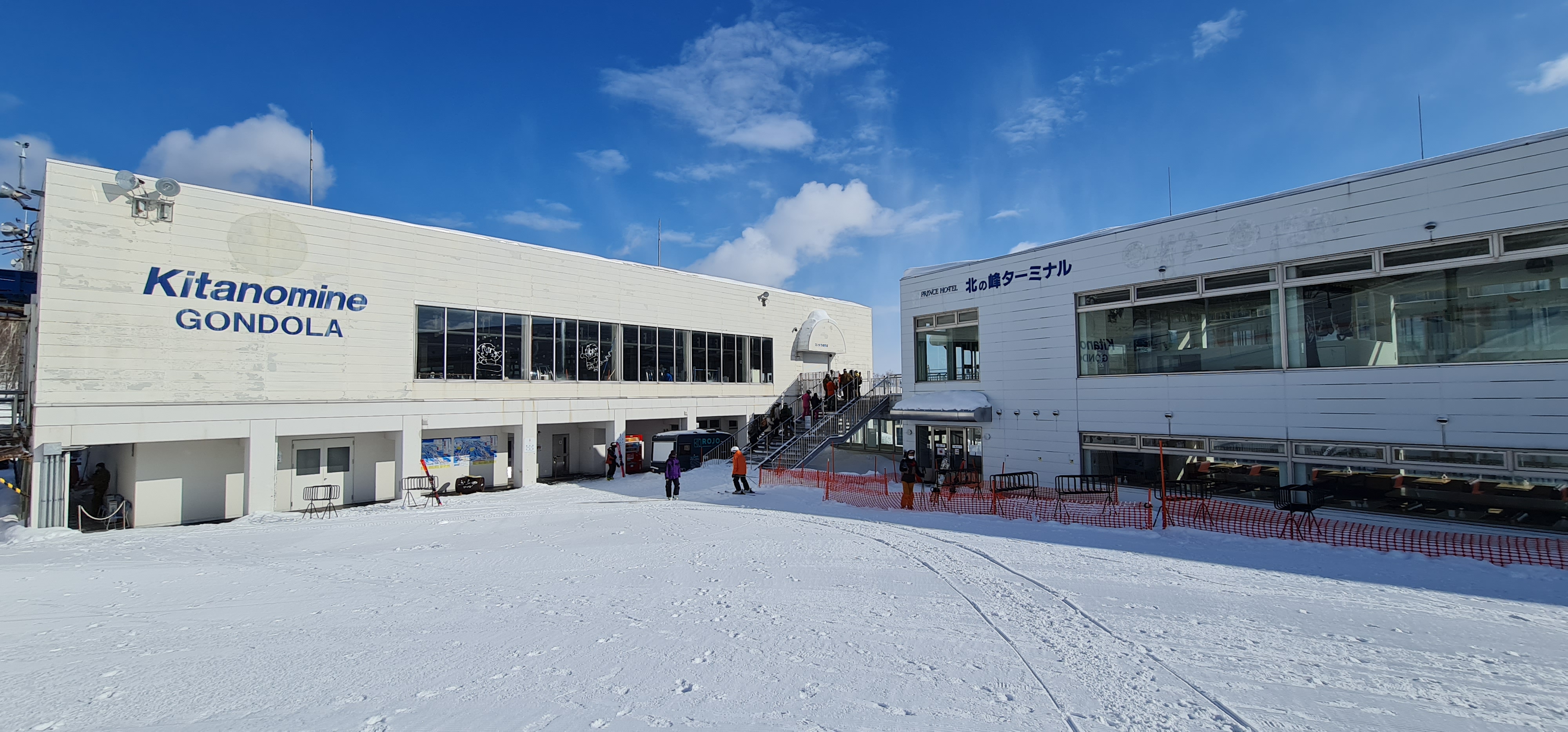
From the Kitanomine Gondola Building - Use the elevator or stairs to make your way up to the first floor (snow level for the ski area). On this level you will find the lift ticket counter, tourism information counter, ski patrol, restaurant and the toilets. If you head out of this building onto the ski area you will notice a large flat area, in front of the restaurant, Rojo coffee caravan and the on snow toliet access doors. This flat area in front of the gondola building is the FISS lesson meeting area.
If you are not sure where you are headed then please make your way up the slope and come into the FISS office to say hello. We can show you the meeting area.
From the FISS Office - Make your way down the slope towards the Kitanomine Gondola Building. Once you pass the magic carpet on your left the slope will flatten to a large area in front of the toilet access doors and the Rojo coffee caravan. This flat area in front of the gondola building is the FISS lesson meeting area.
If you are not sure where you are headed then please come into the office to say hello and we will show you the meeting area.

If your lessons are planned to start at Furano Zone, then unless you have made prior alternative arrangements, you will meet your instructor, commence, and conclude your lesson at our Furano Zone lesson meeting area.
Your instructor will meet you at the meeting area. They will be wearing a bright yellow jacket bearing the FISS logo.
Just approach the nearest FISS employee in yellow, tell them that you are there for your lesson and they will assist you finding your instructor.
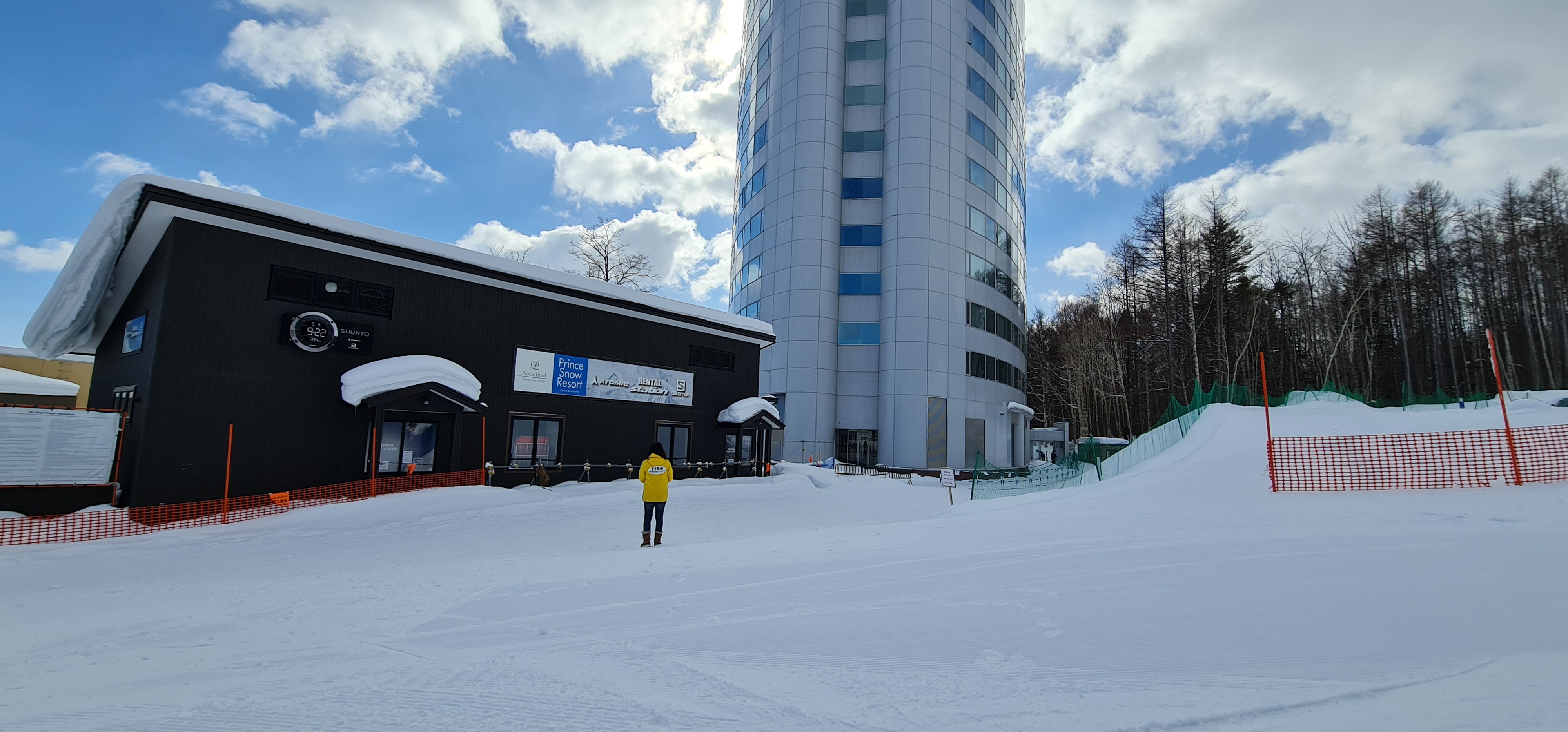
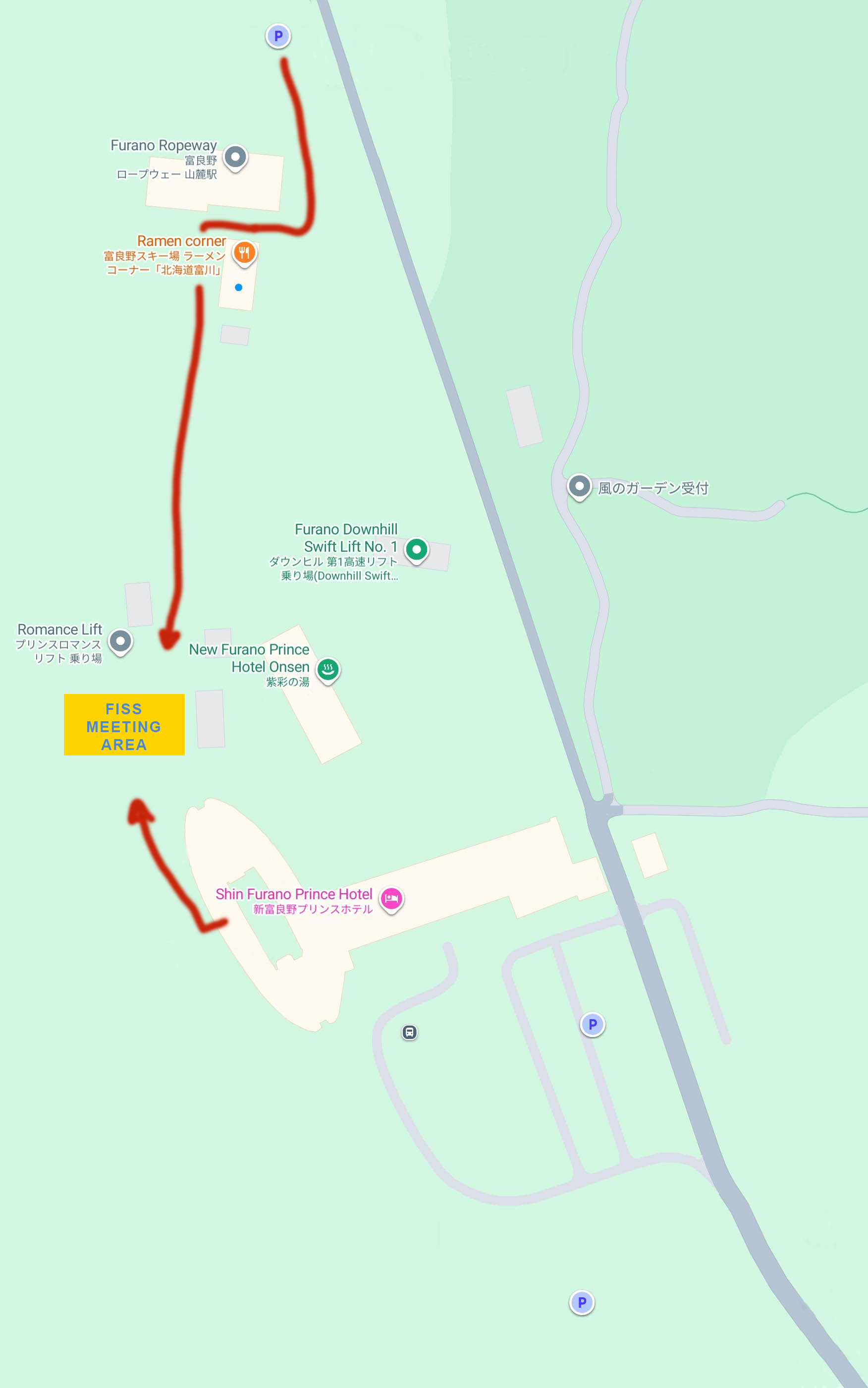
From the Furano Shin Prince Hotel - Use the elevator to make your way to the hotel ski locker room. Walk past the ski rental/accessory shop and lift ticket counter. On your left will be an exit to the ski area. Head out the exit and walk about 40 meters. The FISS lesson meeting area is directly in front of the Atomic Rental Station building.
From the Furano Ropeway - From the carpark head to the ropeway building. Navigate the small staircase in front of the ropeway building so you are on the uphill side. Turn left and make your way past the ramen restaurant. Head up the ski slope in the direction of the chairlifts and Shin Prince Hotel. Immediately after passing the two person beginner chairlift (Romance Lift) load area, you will see the Atomic Rental Station building on your left.
The FISS lesson meeting area is directly in front of the Atomic Rental Station building.
No, unfortunately the prices are only for lessons. We are only a ski school and not a rental company. We specialise in delivering great lessons.
Many options are available. You can rent prior to making your way to resort, or rent from one of the local rental shops.
Our recommendation is to get your rentals in resort. This is for a couple of reasons: Firstly, it saves having to carry the equipment to the resort and having to buy luggage to carry it. Secondly, If there is a problem with the rental equipment or it is incorrectly adjusted, the rental shop can be easily visisted to fix the problem.
Our next recommendation is to look at where you are staying in Furano and choose a rental shop close to your accomodation or zone you plan to ski or ride . This will save you carrying the equipment further than you need and also makes it easier if you need to swap or adjust equipment during your stay.
The FISS office is located adjacent to the Kitanomine Gondola Building in the top car park. When you arrive at the gondola building just scan around and you will hopefully see the large FISS signs on the top of our office.
Unfortunately, we do not have an additional office in the Furano Zone. We do offer lessons from both Kitanomine and Furano Zones, however guests staying in the Furano Zone will find it easier to deal with us remotely via phone or email. Of course if you would prefer to come and see us in person, we welcome your visit and our Kitanomine office is only a short drive/ski/snowboard from Furano Zone.
Our office is open 0815-1600 (Japanese Standard Time) everyday throughout the ski season until the Kitanomine Zone closes.
E-mail: mail@fiss.jp
Tel:(+81) 80 2951 3216
Throughout the rest of the year our office team work remotely to answer all emails and enquiries.
Yes - Absolutely! We welcome you to request a specific instructor, especially if you have previously had a great time with them. Please add in the comments/requests when booking your lesson if you wish to request an instructor. Please be sure to add the instructors first and last names when doing this as we may have several instructors with the same first name. Also please be aware that the lessons are sold on a first come, first served basis. Someone else may have already booked your desired instructor. We will let you know if your prefered instructor is unavailable.
If your wish to guarantee that you get the instructor you wish, then we recommend booking you lessons as early as possible to reduce the likelyhood they will be already booked with a different guest.
Yes - If we have an instructor that speaks the language that you desire, and they haven't already been requested by a previous guest, then we will happily try to accomodate your wishes. Please write in the comments/requests box when making your booking if you have language requests.
Although we will do our utmost to accomodate your request. We cannot guarantee language requests for languages other that English, as all our instructors speak English but only some speak Japanese, Chinese, French, German etc.
We understand that things don’t always go to plan.
Obviously we understand if you need to cancel for any reason (unforeseen events etc), provided you let us know 7 days prior to your booking start, we will happily reimburse your full lesson fees.
Once it gets closer to the booking the harder it is for us to resell those time slots missed.
With this in mind if you cancel:
6 days prior to your booking we will return 80% of your lesson fees.
5 days prior to your booking we will return 60% of your lesson fees.
4 days prior to your booking we will return 40% of your lesson fees.
3 days prior to your booking we will return 20% of your lesson fees.
At 48 hours or less from your lesson start time, it is extremely difficult to get alternative bookings at such short notice, so unfortunately you will not be eligible for any refund as we will use the fee to recuperate the instructors wage cost.
In the event of inclement weather:
Full refunds will be issued if, for reasons such as bad weather or other unforeseen circumstances, Furano Ski Area is forced to close it’s facilities for the period of time that your lesson was due to take place. If it is only a temporary closure of facilities we may offer you a choice between postponing the lesson (if available) or issuing you a refund. If appropriate facilities are available for us to conduct your lesson then your lesson will go ahead as scheduled. We won’t for example issue a refund, just because its snowing.